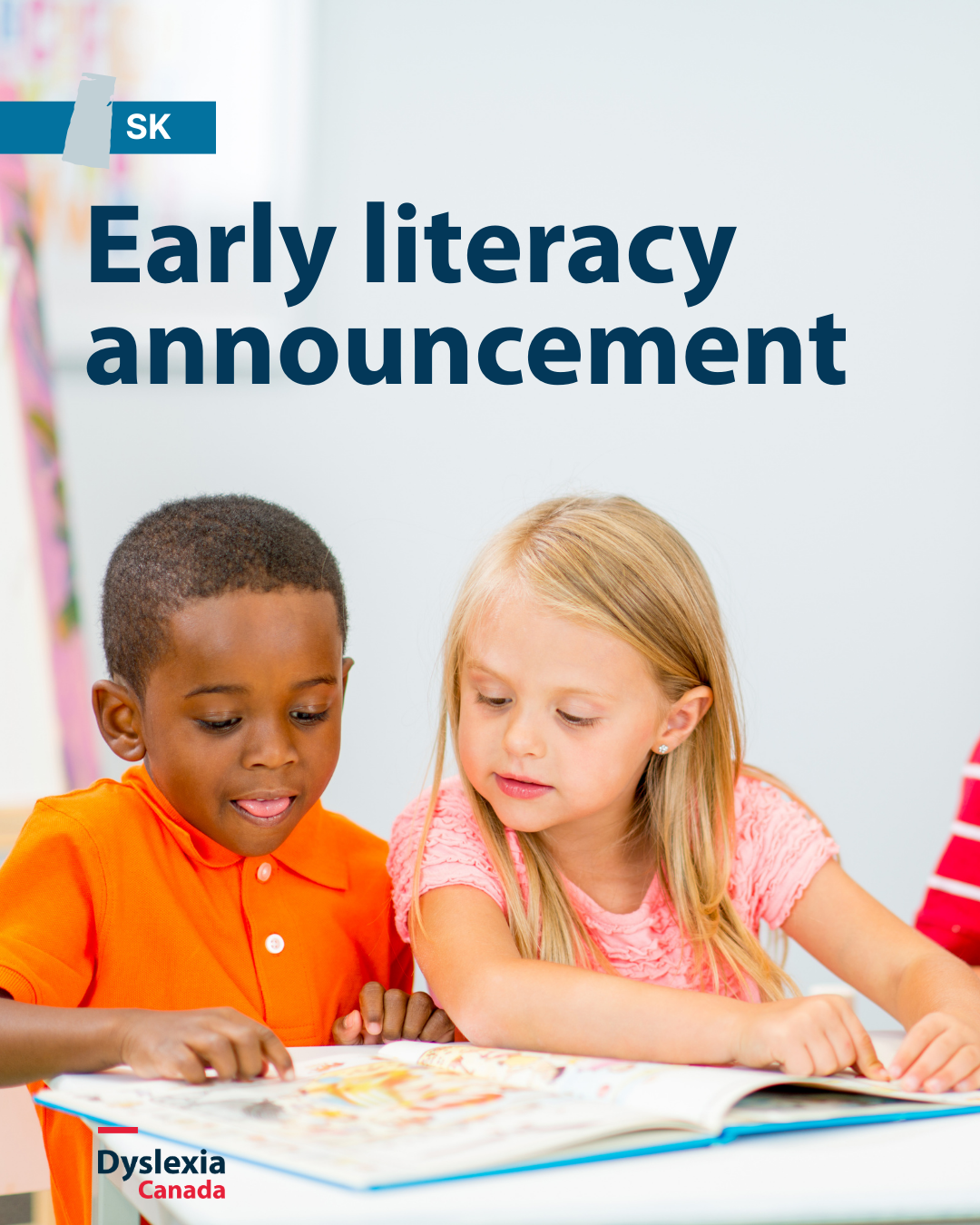
Saskatchewan has signalled an intent to align with structured literacy by releasing a draft ‘Reading Scope and Sequence’ as an appendix to the existing curriculum. However, the original 2010 ELA curriculum still includes references to cueing strategies. We hope to see a complete curriculum rewrite that fully aligns with structured literacy to ensure consistent, evidence-based instruction for students across the province.
 In June 2025, the province released a draft Reading Scope and Sequence that includes specific and measurable expectations for foundational skills from Kindergarten to Grade 3.
While the draft Scope and Sequence does mention structured literacy, the province has not updated or replaced the instructional guidance document Saskatchewan Reads, which does not support structured literacy.
Universal screening was a key recommendation in the Saskatchewan Human Rights Commission’s 2023 report Equitable Education for Students with Reading Disabilities. The province has now announced that screening tools will be provided to schools beginning in the 2026–27 school year, an encouraging step toward earlier identification of students who may need additional support. Several school divisions had already begun screening on their own, ahead of provincial direction.
 Saskatchewan is transitioning away from previous recommendations that schools use levelled reading assessments. As the province works to select evidence-based screening tools, we expect this guidance to be updated.
As a next step, it will be important for the province to establish a clear policy framework that mandates screening and ensures it is implemented consistently across all school divisions, so that every child in Saskatchewan can benefit from early identification and support.
There is no policy or guidance document outlining how schools should use screening data to guide intervention decisions, because the province has not yet required schools to collect or use screening data. Without universal screening in place, this type of policy is not yet possible.
There is currently no requirement in Saskatchewan for schools to use evidence-based interventions. Clear guidance in this area is critical to ensure students receive instruction that is proven to work, and we hope to see the province establish this expectation.
Schools are not currently required to track how interventions are delivered. Such tracking is important for accountability and ensuring that students receive consistent and effective support. We hope the province will introduce a policy in this area.
There is no requirement for schools in Saskatchewan to conduct regular progress monitoring for students receiving intervention. Making this mandatory would help educators adjust instruction and ensure students are on track. We hope to see this added as implementation continues.
Currently, there is no policy in Saskatchewan requiring schools to share information about intervention and progress monitoring with parents. Transparent communication is essential to building trust and ensuring families can advocate effectively for their children. We hope the province will introduce clear expectations in this area.
Saskatchewan does not currently collect intervention outcome data at the provincial level. System-wide data collection is vital to evaluating what’s working and improving practices over time. We hope the province will move in this direction as screening and intervention practices evolve.
While elementary teacher candidates in Saskatchewan must complete six credit hours in reading and language instruction, there are no specific requirements for what must be taught in those courses. Licensing standards do not mandate coursework aligned with the science of reading. Stronger requirements are needed to ensure all teachers understand how children learn to read.
Saskatchewan does not require teachers to take a course on inclusive education, and dyslexia is not specifically named in licensing standards. While teacher candidates must complete six credit hours in educational psychology, there is no guarantee that dyslexia will be covered. As a result, many new teachers may enter the classroom without essential knowledge about how to identify and support students with dyslexia.
Saskatchewan’s professional standards state that teachers must “demonstrate a professional level of knowledge about the curriculum,” but they do not specify knowledge of the essential components of structured literacy. With recent curriculum changes, we hope teacher training programs will align their courses accordingly, but this is not currently required. There is no clear outline of the specific knowledge and skills teachers need to deliver structured literacy. Adding this clarity would help ensure greater consistency in preparation.
Saskatchewan has taken a positive step by partnering with the Saskatchewan Teachers’ Federation to provide professional learning on evidence-based reading instruction. As this work moves forward, it will be important to ensure that professional learning is not a one-time event. Teachers benefit most from sustained, job-embedded learning over time, with opportunities to deepen their understanding, apply new approaches in the classroom, and receive ongoing support.