
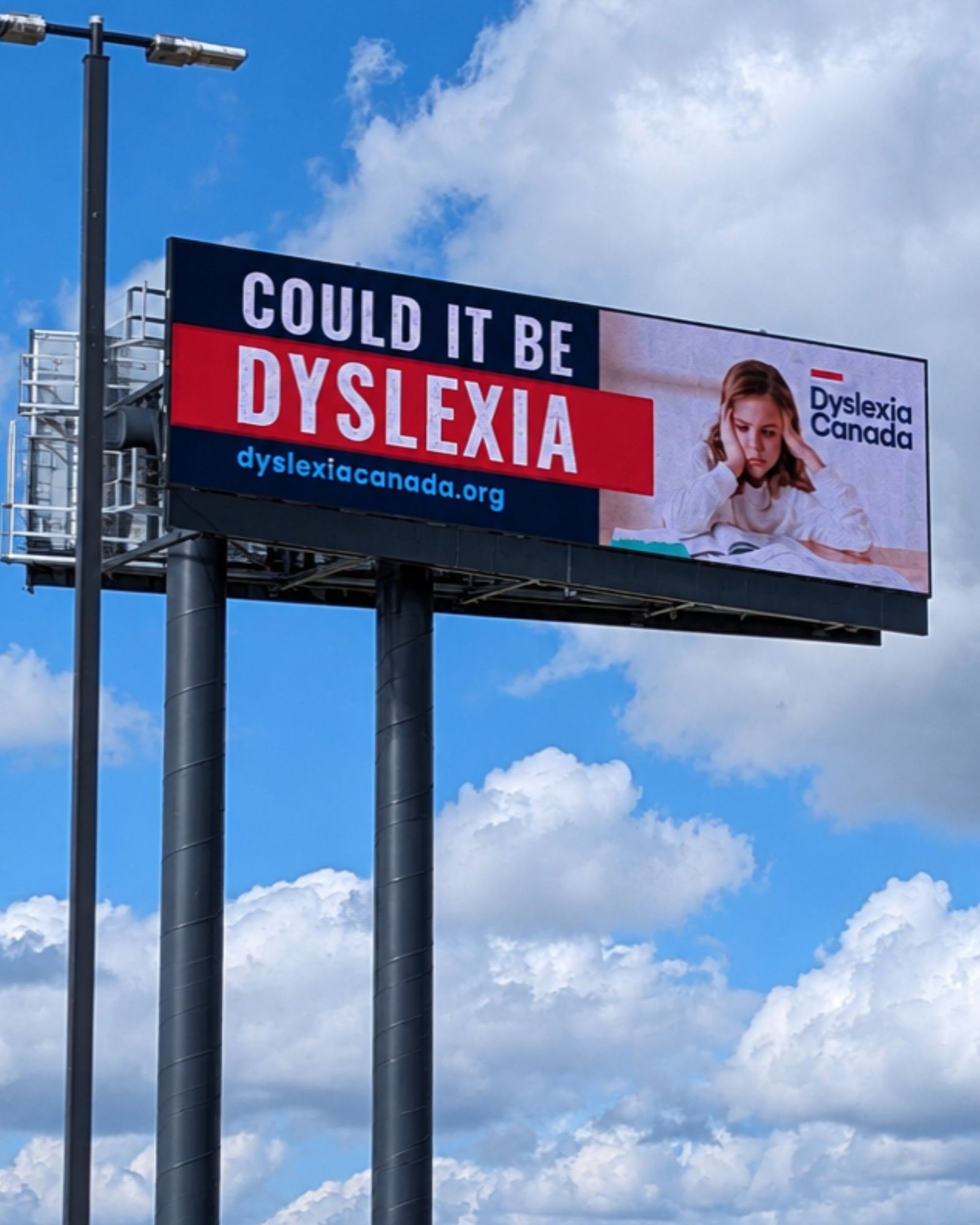
October is Dyslexia Awareness Month. This year, we’re asking people to consider one important question: Could it be dyslexia?
When Dyslexia Canada was founded ten years ago, dyslexia was rarely discussed in schools. Too often, children were moved along from year to year without support or without an understanding of why learning to read was so hard for them. The impacts of unidentified and unsupported dyslexia go well beyond reading and writing. Early challenges with these foundational skills can cause difficulties in learning other subjects. The daily stress of struggling with tasks that others complete easily can erode confidence and self-esteem. That ongoing stress can show up in many different ways: stomach aches, anxiety, behavioural difficulties, or school refusal.
Sometimes, well-meaning efforts to help a child focus on these secondary impacts instead of the root cause. Support for behaviour, attendance, or mental health needs is very important, but if the underlying dyslexia is overlooked, the struggles are likely to continue.
This October, our challenge to Canadians: if you know a child or young person who is struggling, ask the question, could it be dyslexia?
Thanks to PATTISON Outdoor’s generous donation of $1 million in advertising space, this question will appear on billboards and signs at over 1,200 high-traffic locations across Ontario this month. We’ll be sharing this message across Canada through social media. Please help us amplify it by sharing it with your networks.
Recognizing the signs
Individuals with dyslexia may:
- Have difficulty learning the alphabet and the sounds that letters represent
- Have problems rhyming or noticing sounds in words
- Struggle to sound out unfamiliar words
- Read slowly or with effort
- Avoid reading and writing tasks
- Have difficulty spelling even common words
- Know more than they can easily show in writing
If you suspect dyslexia, what should you do?
For parents of children in Kindergarten to Grade 2
If you’re concerned about your child’s reading development, you are most likely starting from a better position than parents were a decade ago. This fall, approximately 72% of Canadian children in Kindergarten to Grade 2 should receive reading screening at school under provincial requirements. When Dyslexia Canada was founded ten years ago, that percentage was zero.
Early screening uses brief, targeted assessments to help teachers plan effective classroom instruction and identify students who need intervention.
Screening doesn’t diagnose dyslexia, but it plays an important role in identification. A modern approach to assessing learning disabilities considers how a child responds to evidence-based instruction and intervention. A psychologist can use screening data, intervention records, and progress monitoring data, alongside targeted additional assessments, to identify learning disabilities like dyslexia earlier and more efficiently than in the past.
However, parents should know that while most provinces now require early reading screening, very few have policies requiring schools to provide intervention in response to the results, track intervention delivery, and monitor and record student progress.
The level of documentation and the length of time screening and intervention records are kept by schools vary widely. It isn’t safe to assume that your child’s school will have all the information available to support a timely assessment for your child if it is needed, so ask for copies of your child’s screening results and hang on to them.
If the results indicate that your child is “at risk” or “below benchmark”, download our Parent Handbook. It includes detailed questions to ask your school about how they will support your child, as well as strategies to help you advocate effectively.
When your child is receiving intervention, ask for details and keep them alongside screening results and progress updates. Maintaining these records from year to year can help ensure everyone understands what has already been tried, what is working and if a formal assessment should be considered.
For parents of children in Grade 3 and above
Provincial policy changes for students in Grade 3 and above have been more limited. Despite this, professional learning and changes in practices for the younger grades may cause shifts in instruction and support for older students.
If you’re concerned about your child’s reading development, talk to their teacher. Ask whether your child has been screened and, if not, whether screening can be arranged. While most provinces don’t require screening in Grade 3 and beyond, as screening in Kindergarten through Grade 2 has become more widespread, many districts, schools, and teachers recognize its value and are voluntarily screening older students.
At this age, if your child is struggling with reading, intervention should start without delay. Schools can use screening and other teacher-administered assessments to plan intervention and monitor your child’s progress. While a psychoeducational assessment may be helpful, the Ontario Human Rights Commission’s 2022 Right to Read report affirmed that students must not be required to have a professional assessment or diagnosis before receiving intervention or accommodations.
Unfortunately, accessing effective reading intervention at school can still be very difficult. Only about 17% of Canadians live in provinces with detailed reading intervention policies. This doesn’t mean that only 17% of children who need intervention receive it, and it also doesn’t mean that support is consistently effective in the provinces that do have policies. But without clear policies that establish consistent processes and systems, schools and districts are left to work out an approach on their own. That means the availability and effectiveness of interventions vary considerably depending on where you live, and many parents still need to advocate extensively for their children to receive support at school.
If you are struggling to get help for your child, Dyslexia Compass can support you as you navigate conversations with the school and explore next steps.
For educators
Screening all students at least twice a year is a valuable starting point for understanding your class’s reading needs. If your school or district does not provide screening tools, evidence-based options with free assessment materials include DIBELS 8th Edition and Acadience Reading.
Training and practice are essential for accurate administration, scoring, and interpretation. If you haven’t received training through your school or district, there are other ways to build these skills. Start with the administration manual for your chosen tool and explore aligned resources, such as these free oral reading fluency training videos and practice materials. Colleagues with training and experience can also help you get started. Observing them screen students and receiving constructive feedback as you practise can help you apply the procedures accurately and consistently.
Schools and districts have an important role in providing screening tools, training, and time to learn together. Ask your principal what support is available. Free resources and supported practice can help you build screening skills while preserving limited professional development funds for learning about effective reading instruction. The goal is to use screening results to guide instruction that meets students’ needs.
When you begin screening, you may be surprised to find that a large proportion of your students, sometimes more than half the class, score in the “at-risk” or “below benchmark” categories. This does not mean they all have dyslexia or need one-to-one intervention. It signals a need to identify shared skill gaps and address them through strong core classroom instruction. ONlit’s article on classroom-level collaborative problem solving explains how to move from screening results to an instructional plan for the whole class.
Screening can also help you determine which students may need intervention in addition to strong core classroom instruction. Our Making Sense of Screening Decision Tree can help you understand where reading is breaking down, what additional assessments you might consider, and what the instructional focus should be for the student. You can also use the student-level problem-solving process and worksheet to develop a plan to help them close the gap.
Keep parents involved throughout. Share the common signs of dyslexia, what you have noticed, and invite them to share their own observations. Explain the screening and assessment results, the skills they need support with, and your plan to help them develop those skills. Offer practical suggestions for how they can reinforce learning at home, while recognizing that families have different circumstances and abilities to provide support.
If you need help interpreting your class’s data or planning support for an individual student, visit ONlit.org or contact our team at info@ONlit.org.
For healthcare professionals, social workers, and youth workers
If you are supporting a child or young adult with anxiety, depression, behavioural challenges, school refusal, risky behaviour, or substance use concerns, consider whether an unidentified reading difficulty could be contributing. Dyslexia isn’t always the underlying issue, but young people with dyslexia are at greater risk of experiencing these challenges.
Ask about their experience of learning to read and write. Find out whether they have received reading screening or other assessments, what support has been provided, and whether it has helped. Ensuring that dyslexia is properly identified and supported can be an important part of helping with the challenges that first brought the young person to you.
The Canadian Pediatric Society’s position statement on literacy provides practical guidance for healthcare professionals on reading development and assessment, and on helping families access effective instruction and support at school. You can also refer families to our Dyslexia Compass program for support.
Whatever your role, if you see a young person struggling, ask the question: “Could it be dyslexia?”
Learn the signs. Start the conversation. That first step can lead to understanding and support that can change a life. Don’t wait to see if things get better on their own. The earlier support begins, the better, but it is also never too late to help.
This October, share our campaign messages with your networks. Together, we can help more children and young adults get the support they need. With effective instruction, intervention, and support, young people with dyslexia can thrive.