
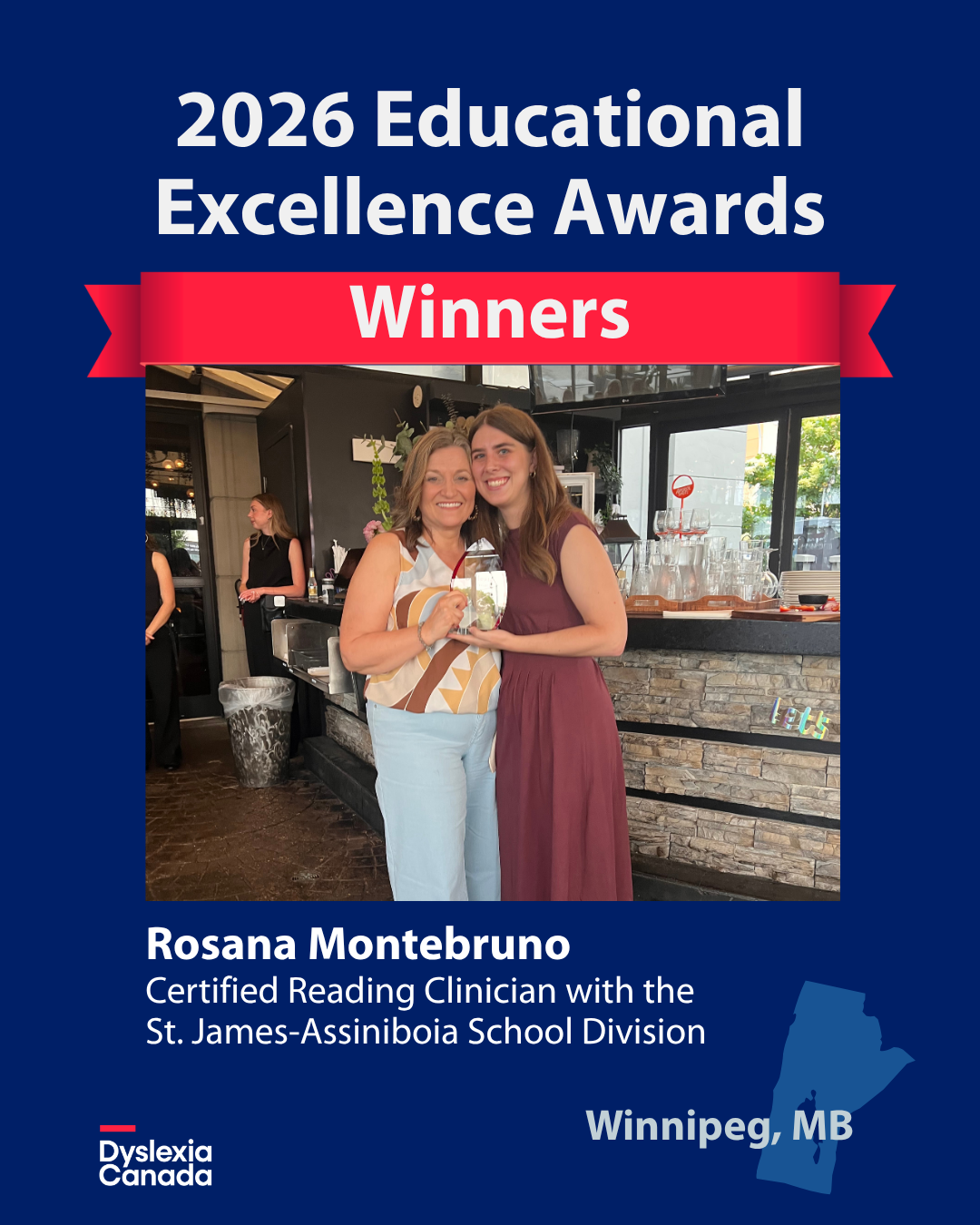
Each year, Dyslexia Canada’s Educational Excellence Awards recognize those making a meaningful difference in the lives of students with dyslexia. These awards celebrate educators who embrace evidence-based practices, prioritize early identification, and work to ensure that every student has the opportunity to learn to read.
2026 marks Dyslexia Canada’s milestone tenth anniversary, and it is an honour to celebrate with this year’s remarkable group of award winners from across Canada.
Rosana Montebruno has spent 40 years working to improve reading instruction for students and educators in Manitoba, and her commitment to evidence-based literacy instruction, professional learning, and system change has led her to receive a 2026 Dyslexia Canada Educational Excellence Award.
A Certified Reading Clinician with the St. James-Assiniboia School Division, Rosana received the award at her retirement celebration, where Dyslexia Canada team member Tianna Voort recognized a career dedicated to strengthening literacy instruction and advocating for better outcomes for students.
Rosana began teaching in 1985, at the height of the whole-language movement. “I can’t imagine anything being more whole language than what I entered into,” she remembers. She loved its emphasis on literature, storytelling and writing, but when she began working with students with language disorders, she started to question the approach. Many of her students weren’t learning to read, and she didn’t know how to teach them.
Eager to learn, Rosana trained as a Reading Recovery teacher leader and eventually helped put the program in practice in Manitoba. She learned a great deal from the experience, but again found that some students continued to struggle. “It just wasn’t enough for the students that really needed support.”
That realization pushed Rosana to keep learning. She began exploring research on how children learn to read and incorporated more systematic and explicit instruction into her practice. This time, she began seeing a difference. “I started seeing the differences in learning and in students”, she recalls. Seeing what was possible with a more structured approach motivated her to continue learning and, eventually, to help other educators make those same shifts.
Over time, Rosana’s work expanded beyond her own students. She helped build St. James-Assiniboia’s Clinical Reading Team from the ground up, increasing the support available to students and educators across the division. She also championed universal early reading screening, helping bring it to the division ahead of the provincial mandate and supporting teachers to use screening data to guide instruction and intervention.
Rosana has also volunteered her time to help drive change across Manitoba. Through the Manitoba Literacy Alliance, she has advocated for stronger curriculum and universal early reading screening and helped organize professional learning opportunities for educators. In 2025, Manitoba introduced universal screening from Kindergarten to Grade 4, an important step forward after years of advocacy.
Rosana pushes back on the idea that these changes represent another “pendulum swing” in reading instruction. After four decades in Manitoba’s education system, that isn’t what she has seen.
“That pendulum has never really swung here in Manitoba,” she says. “We’ve maybe made our way very, very, very, very slowly, and I’d argue we’re still on that path.”
For Rosana, one of the most significant changes over her career has been a shift in expectations for students. She remembers greater acceptance that some children simply wouldn’t become strong readers, or that struggling students just needed more time. Today, those assumptions are increasingly being challenged as parents, educators, and advocacy organizations learn more about what is possible with effective instruction and intervention.
When asked what she is most proud of after 40 years in education, Rosana points to the educators around her. “Honestly, I’m really proud of the work that our teachers have done,” she says, particularly “the work in their own thinking and their own self-reflection.”
She has watched educators question long-held beliefs, embrace new learning, and make significant changes to their practice. Along with colleagues Carrie Wood and Allison Aitken, Rosana organized voluntary, after-school professional learning sessions on universal screening. With no funding available, they weren’t sure how many educators would attend. Instead, 150 joined them on their own time. “Teachers are interested. They want change. They see a need for change.”
For Rosana, supporting educators will be essential to sustaining that momentum. “We really have a responsibility to support our teachers, especially our classroom teachers, in this journey.” As Manitoba moves forward with universal screening, she sees ensuring educators have the knowledge and support to understand the data and respond effectively as an important next step.
While Rosana is retiring from her formal role, she isn’t stepping away from the work. She plans to continue volunteering, advocating for change and supporting colleagues as Manitoba moves forward.
As Rosana puts it, “I think everything’s changed, but I think we’re still changing.”
After 40 years in education, Rosana leaves behind stronger systems, greater knowledge, and a growing community of educators committed to improving reading outcomes. The work she has helped advance in Manitoba will continue, and so will her contribution to it.