
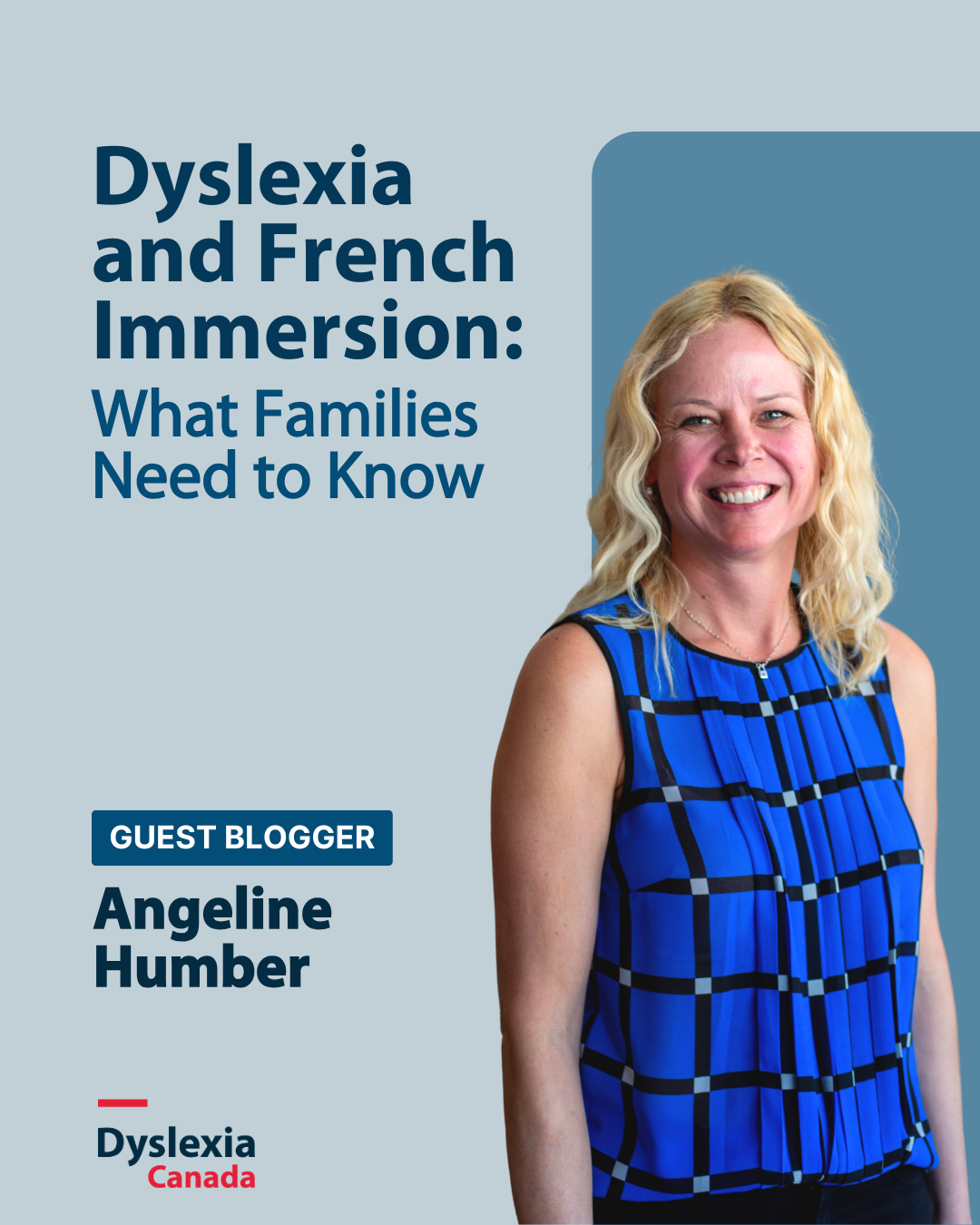
As a long‑time French Immersion (FI) teacher and French as a Second Language Teacher Consultant, one of the most frequent questions families bring to me is:
“My child is struggling at school. Should they stay in French Immersion?”
This is a question I have heard many times over the years. Each time, I know that for the family raising it, the situation is unfamiliar and often accompanied by a great deal of emotion and uncertainty. Many parents and caregivers spend months, or even years, noticing that their child’s literacy skills are not progressing as expected. For some children, this eventually leads to an assessment and a diagnosis of dyslexia.
If this is where you find yourself, I want to begin by acknowledging that your questions are valid, and you are not alone in asking them. This is why Dyslexia Canada has developed and shared French Immersion FAQs on their website. The responses are intended to provide clarity, reassurance, and practical guidance based on current research, while helping families understand how French Immersion supports reading development and how to best support their child along the way.
Understanding French Immersion and Dyslexia
Throughout my career, I have had the privilege of working with a diverse range of learners—some who take to learning a new language quickly, and others whose progress is more gradual. Through these experiences, one message has become especially important to share with families:
Dyslexia is not, in itself, a barrier to learning French.
French Immersion is not inherently “too difficult” for dyslexic learners. Challenges arise when structured literacy practices are not in place, when early indicators are missed, when families lack clear information about appropriate supports, and when systems lack sufficient resources for targeted intervention.
With effective support, students with dyslexia can communicate confidently in French and can develop reading and writing skills in the language. The most effective supports typically include:
- explicit, systematic instruction
- structured literacy approaches
- targeted interventions
- collaboration between school teams and families
And above all, students need educators who see their strengths—not just their challenges!
Why Families Worry – And Why It Makes Sense
Even with strong FI programs across Canada, it is completely understandable that families have concerns. The questions I hear most often include:
- “Will learning two languages confuse my child?”
- “Shouldn’t they learn to read in English first?”
- “Will they fall behind even more?”
- “Would switching to English help reduce frustration?”
These questions reflect careful consideration of a child’s learning needs. While learners with dyslexia are already navigating a complex linguistic landscape, adding French does not create the underlying reading difficulty. In many cases, French Immersion may reveal these challenges earlier—allowing educators to intervene sooner. Early identification and targeted support contribute to significantly better long-term outcomes, regardless of the language of instruction.
What Effective Support in FI Looks Like
Support for dyslexic learners varies across regions and school boards/districts. Some FI programs already use strong structured literacy approaches, while others are continuing to build their capacity. In my work as both a teacher and consultant, I have seen the notable difference that appropriate tools, training, and collaboration can make.
Here are key components of effective support in FI:
1. Structured Literacy in French
Learners with dyslexia often show strengths in reasoning, creative thinking, oral language skills, and problem solving, which can complement learning French as an additional language and strongly support language comprehension. To develop word recognition and decoding skills, explicit instruction in phonemic awareness, grapheme–phoneme relationships, morphology, and orthographic patterns—particularly those specific to French—is essential.
2. Early and Frequent Assessment
Early screening and frequent progress monitoring helps ensure literacy challenges are recognized early and addressed proactively.
3. Bilingual Collaboration
Close coordination between English and French teams is highly beneficial. Many literacy skills transfer across languages, and a bilingual support plan can reinforce this connection.
4. Appropriate Accommodations
Access to supports such as audiobooks, text-to-speech and speech-to-text tools, extra time, decodable texts, and small group instruction promotes equitable learning experiences.
5. A Supportive Team Environment
A positive, encouraging learning environment helps students engage academically and approach challenges with confidence.
Why Many Dyslexic Students Thrive in French Immersion
Families are often surprised to learn that FI can offer meaningful advantages for dyslexic learners. Benefits include:
- A strong emphasis on oral language development, building comprehension before reading demands increase
- Enhanced metalinguistic awareness, cognitive flexibility, and vocabulary growth—skills associated with bilingualism
- Exposure to two writing systems, supporting a deeper understanding of language structure and patterns
And most notably:
French Immersion provides additional pathways into literacy.
Some children respond particularly well to the more predictable sound–letter relationships found in French. This increased predictability can complement their English literacy development by reducing cognitive load during decoding and supporting more consistent application of phonics knowledge. For these children, French can serve as an alternative entry point to reading, allowing foundational decoding skills, confidence, and automaticity to develop in a more transparent orthographic system, which can then transfer to reading in English.
Acknowledging the Team Behind the FAQs
When developing the French Immersion FAQ section for Dyslexia Canada, we were fortunate to work with a dedicated group of experts who generously shared their time, experience, and insights:
- Nellie Caruso
- Leigh Fettes
- Dr. Nancy Wise
- Janelle Rowlatt
- Tianna Voort
Their thoughtful input reflects a deep professional commitment to student well‑being and a shared belief in the potential of every learner. I am grateful for their expertise and collaboration.
You Are Not Alone
Every child is unique, and every family’s situation requires individualized consideration. Families should never feel that they must make decisions in isolation.
For this reason, Dyslexia Canada created the Dyslexia Compass program—designed to help families navigate decision making around questions like French Immersion, transitions, supports, assessment, and more. Click here to register for the program. Dr. Nancy Wise, a lead FI volunteer for the program, brings extensive experience in both dyslexia and bilingual education and has supported many families seeking clarity and direction.
If you have questions, Dyslexia Canada is here to help. They are a team who understands and strives to support.
– Angeline Humber
Angeline Humber is an award-winning Teacher Consultant (K–12) at the Greater Essex County DSB, deeply committed to the success of all students in French Immersion.
Angeline has made significant contributions to the field through her collaborative work with researchers at the University of Florida to develop Son-au-graphe, a French adaptation of UFLI Foundations that provides educators with free, practical, classroom-ready tools grounded in reading science. She also led an interdisciplinary team in the development of ÉCLAIR, a diagnostic assessment tool designed to support student success in French Immersion.
In addition to her resource development work, Angeline leads ONlit drop-in sessions, creating welcoming spaces for educators to ask questions, share knowledge, and deepen their understanding of effective literacy instruction.
Through her leadership, collaboration, and ongoing support of educators, Angeline continues to have a meaningful impact on students. Dyslexia Canada is deeply grateful to her for sharing her time and expertise to support our community.