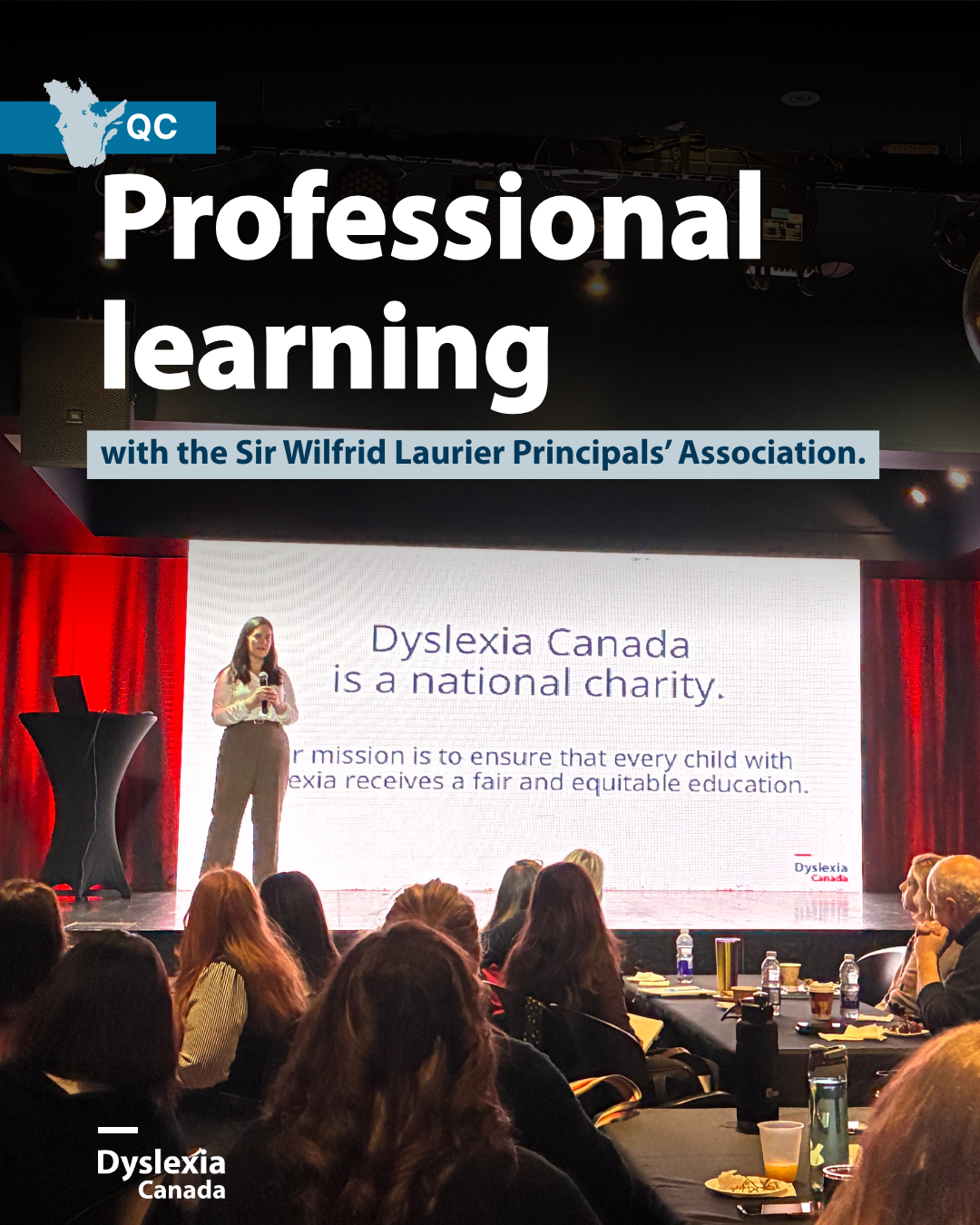
Last week, I travelled to Laval, Quebec with Dr. Una Malcolm, Dyslexia Canada’s Chief Academic Officer, for a day of professional learning with the Sir Wilfrid Laurier Principals’ Association. Una and I have had the pleasure of presenting to educators and parents from coast to coast, but this was the first time we were invited to deliver professional development in a cabaret club, complete with a disco ball and a working smoke machine. It was definitely a memorable day!
I was happy to be invited back to deliver a follow-up session after speaking with this group last spring. That first presentation focused on the importance of ensuring that all children get off to a good start in learning to read. We talked about the science of reading, the importance of strong core instruction in foundational skills, and the role of universal screening in ensuring that the needs of all students are recognized early. Catching reading difficulties early matters because it allows schools to respond before children experience the academic and emotional consequences of falling behind.
One of the key challenges these educators face is Quebec’s outdated English Language Arts Program.
While Quebec has recently updated the French Language Arts Program to focus on essential foundational skills, the English Language Arts Program remains grounded in the outdated whole-language approach. The English curriculum does not clearly outline expectations for foundational skills such as learning the alphabet, printing, phonemic awareness, phonics, and decoding. This lack of clarity means instruction and assessment can look very different from one classroom to the next, and too often it means students with dyslexia struggle for longer than they should before their needs are identified and communicated to parents.
What was especially encouraging during this visit was learning how the Sir Wilfrid Laurier School Board is not waiting for curriculum change to do the right thing for students. The board has been working proactively to bring evidence-informed literacy practices into schools, including the use of DIBELS 8 as a universal screening tool.
Una spoke about how screening data can be used not just to support individual students, but also to spot patterns, ask better questions, and guide decision-making at the school and system levels.
Disco ball and smoke machine aside, we enjoyed our day with this thoughtful and committed group of school leaders. We are grateful for their openness and their ongoing work to strengthen literacy outcomes for all students by moving toward evidence-aligned instruction and early screening.