 New Brunswick was a national leader in moving away from three-cueing and promoting evidence-based reading instruction. In 2021, the province released the Building Blocks of Reading Continuum and Foundational Reading Skill Development Companion Documents, which set a clear and explicit direction for early literacy. These documents identified three-cueing as an example of a practice not supported by evidence, which should be discontinued.
“Pedagogical practices that are not supported by compelling or promising research findings should not play a central role in core instructional practices and should be avoided if they are contraindicated by empirically supported theory (e.g., the three-cueing approach to word recognition is not supported by compelling or promising research and runs counter to research supported theory that describes how children learn to read).” – Research in Reading Instruction, New Brunswick, 2021
New Brunswick’s English Language Arts curriculum provides clear, specific, and measurable expectations for foundational skills in the early grades. The guidance is straightforward, practical, and grounded in research, making New Brunswick one of the first provinces in Canada to take such a strong and public stance in support of the science of reading.
New Brunswick has provided very clear communication about the importance of using structured literacy approaches in early reading instruction. Instructional guidance emphasizes explicit teaching of foundational skills, including phonemic awareness, phonics, and decoding strategies, and discourages the use of cueing systems. This alignment supports educators in delivering evidence-based instruction to improve student outcomes.
 New Brunswick’s leadership deserves credit for recognizing that a shift to structured literacy cannot happen without assessment tools that provide actionable insight into students’ foundational skills. The province took decisive action by intentionally de-implementing levelled reading assessments and providing teachers with an alternative.
Rather than selecting an existing evidence-based screening tool, the province chose to develop its own assessment: the Early Grades Literacy Assessment (EGLA). While not a screener, the EGLA functions more as a skills inventory. Educators we’ve surveyed report that it provides information that is far more useful than the old running records, but they also note that it takes significant time to administer and lacks benchmarks or norms.
 New Brunswick does not currently require schools to use screening tools that are evidence-based, valid, and reliable. The Early Grades Literacy Assessment (EGLA), while an improvement over levelled reading assessments, does not meet the criteria for an evidence-based screener. It lacks established validity and reliability data and does not provide benchmarks or norms for identifying students at risk.
New Brunswick currently requires schools to administer the Early Grades Literacy Assessment (EGLA) to all students from Kindergarten to Grade 2. However, the EGLA is positioned as a continual assessment, with teachers expected to assess various skills for different students on an ongoing basis throughout the year.
While it’s important to collect quality data to guide instruction, it is equally important to maximize instructional time. Screening is intended to be quick, designed to identify which students may need further assessment and support. Testing all skills for all students is not always necessary and can reduce the time available for teaching.
We encourage the province to implement a quick, universal screener administered to all K–2 students at least twice per year. Components of the EGLA could then be repurposed as follow-up diagnostic tools for students flagged by the screener for more in-depth assessment, ensuring as much time as possible is available for instruction.
While the Ministry of Education and Early Childhood Development is responsible for crediting teacher training programs in New Brunswick, we found no evidence that the ministry currently requires universities to include reading science in their coursework. Without clear expectations, the depth and quality of preparation in evidence-based reading instruction can vary widely.
We found no evidence that training in dyslexia is a required component of teacher preparation in New Brunswick. Leaving this to chance means many new teachers may graduate without the knowledge and tools needed to identify and support students with reading disabilities.
We were not able to find licensing standards that clearly outline the knowledge and skills necessary to teach structured literacy. With the release of the Building Blocks of Reading and companion documents, we are hopeful that universities are aligning their programs accordingly. However, formalizing these expectations through clear provincial standards would provide greater consistency and ensure this critical knowledge is not overlooked.
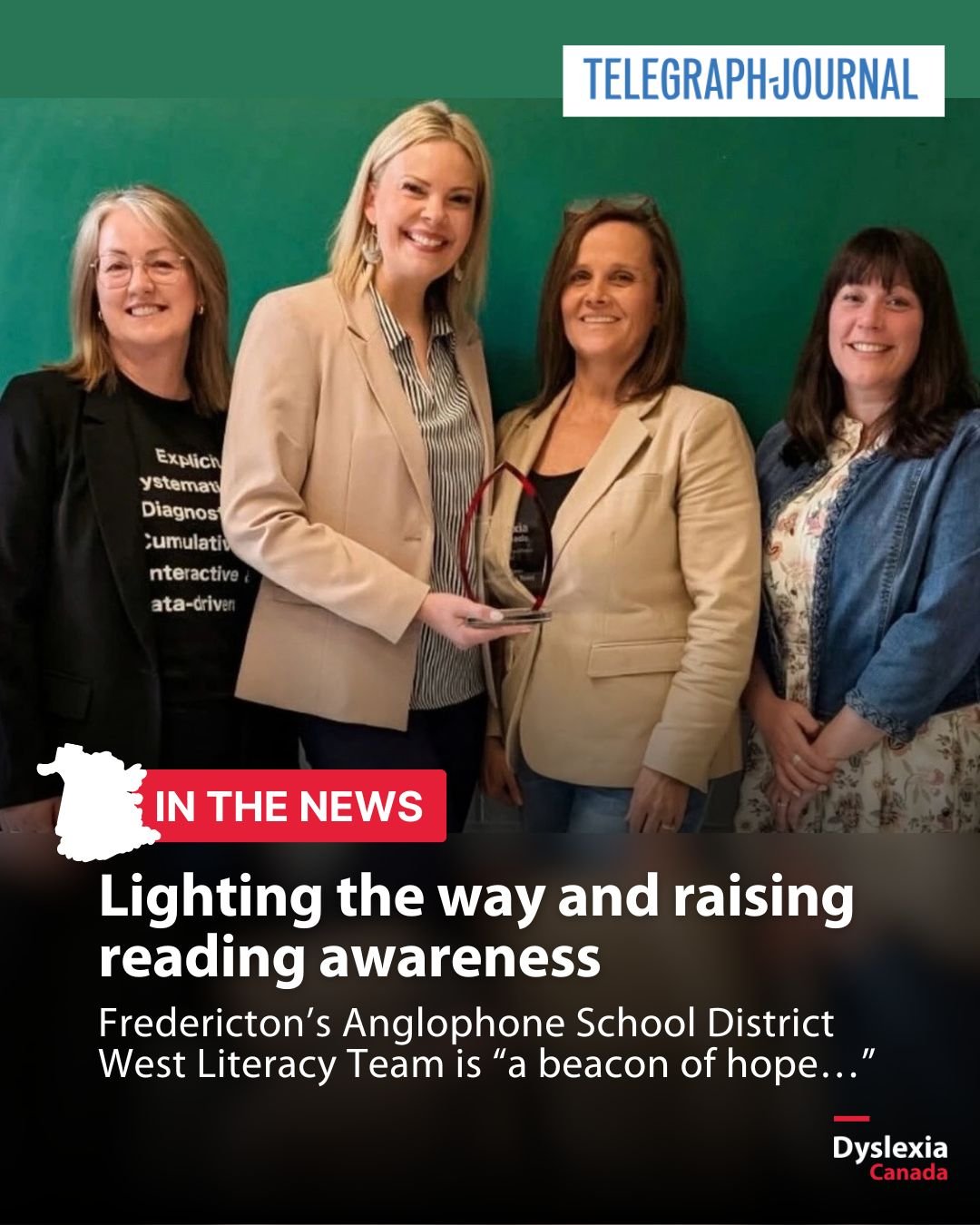
New Brunswick has made important investments in professional learning. The province created an online module to introduce teachers to the Building Blocks of Reading continuum and reported a 98% completion rate. In addition, they have invested in coaching, a highly effective method for supporting sustained changes in practice. The Anglophone West K–5 Literacy Team is a standout example of this work; they received Dyslexia Canada’s Educational Excellence Award in 2025 for their leadership.