 Manitoba’s English Language Arts (ELA) curriculum still includes references to three-cueing and has not been updated to align with structured literacy. Despite public calls for change, including scrutiny from the Manitoba Human Rights Commission’s Special Project on the Rights of Students with Reading Disabilities, the province has not yet removed cueing strategies. A full curriculum rewrite is needed to ensure consistent, evidence-based instruction.
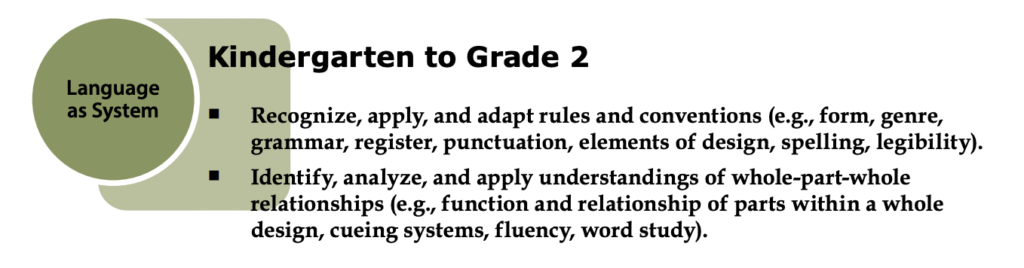
The Manitoba curriculum does not provide specific or measurable expectations for foundational skills. The outcomes and indicators are vaguely worded and emphasize higher-order skills, like the expectation from kindergarten to grade 2 that students will “recognize and analyze inequities, viewpoints, and bias in texts and ideas” and “investigate complex moral and ethical issues and conflicts,” without any specific expectations for the foundational reading and writing skills necessary to meaningful engage in those higher order activities. The language of “multi-literacies” introduces further ambiguity, framing reading and writing as just one of many ways children might construct meaning, rather than essential skills that every child must master. This lack of clarity is deeply problematic for ensuring literacy success.
The instructional guidance in Manitoba’s curriculum is rooted in outdated whole language beliefs, assuming that children will learn to read and write through exposure and discovery. There is no mention of explicit instruction, and in 130+ pages of curriculum documents, the words phonics and phonemic awareness do not appear. Children are expected to write reports and express ideas without being taught how to hold a pencil or form letters. Unsurprisingly, Manitoba ranks last in reading on the Pan-Canadian Assessment, highlighting the consequences of this ineffective approach.
 In April 2025, Manitoba announced it will implement universal early reading screening for all students in kindergarten to grade 4, starting in September 2025. This is a critical step toward identifying students at risk and ensuring timely support. We’re glad to see the province taking action to improve early literacy outcomes.
 The Minister has promised that school boards will be required to use screening tools that are evidence-based, valid, and reliable, but we are still awaiting official guidance. We hope Manitoba will look to the strong examples set by Ontario and British Columbia when developing these requirements.
While the Manitoba government has promised to implement early reading screening, there is currently no official policy or regulation requiring schools to screen all students in kindergarten to grade 2 at least twice a year. However, a private member’s bill proposing mandatory screening and monitoring for learning disabilities is expected to go to committee in the fall of 2025.
Manitoba has not yet released a policy outlining how schools should use screening data to guide intervention. With universal screening starting in fall 2025, we hope clear guidance will follow to ensure screening results are used effectively to support students.
Manitoba does not currently require the use of evidence-based interventions. The province has a long history with Reading Recovery; while school boards in most provinces have moved away from it in recent years, Manitoba continues to use the program. We hope Manitoba will take this opportunity to define expectations and ensure all students receive interventions proven to work.
Schools in Manitoba are not currently required to track how regularly and often interventions are delivered. As the province moves forward with screening implementation, we hope it will also establish policies that promote accountability and consistency in intervention delivery.
There is no requirement for schools in Manitoba to conduct regular progress monitoring for students receiving intervention. Introducing this expectation would help educators tailor instruction and ensure students are making progress. We’re hopeful this will be part of the province’s next steps.
Manitoba does not currently collect intervention outcome data at the provincial level. As screening rolls out, this kind of system-wide data collection will be critical for evaluating what works and improving outcomes, something the province desperately needs given its last-place ranking in national reading results.
Manitoba’s teacher licensing standards do not specifically require coursework in the science of reading. While some teacher education programs may include relevant content, it is not mandated or outlined in provincial certification requirements. Since licensure is administered directly by the Ministry of Education and Early Childhood Learning, Manitoba is well-positioned to move swiftly to update its standards in this area.
While teacher candidates in Manitoba must complete six credit hours in special education, there is no requirement that these courses cover dyslexia or other learning disabilities. Without clear expectations, many teachers may graduate without the knowledge needed to identify or support students with dyslexia. A more explicit focus would help ensure teachers are prepared to meet the needs of all learners.
Manitoba’s licensing standards do not specify that teachers must demonstrate knowledge of the core components of structured literacy. As the province begins implementing early screening, updating certification requirements to reflect these essential skills will help ensure consistency and effectiveness in reading instruction.
At this time, there is no coordinated provincial investment in professional development focused on structured literacy. Supporting teachers through high-quality training will be essential to the success of the new screening initiative and to improving student outcomes across the province.